The Laboratory Fallacy
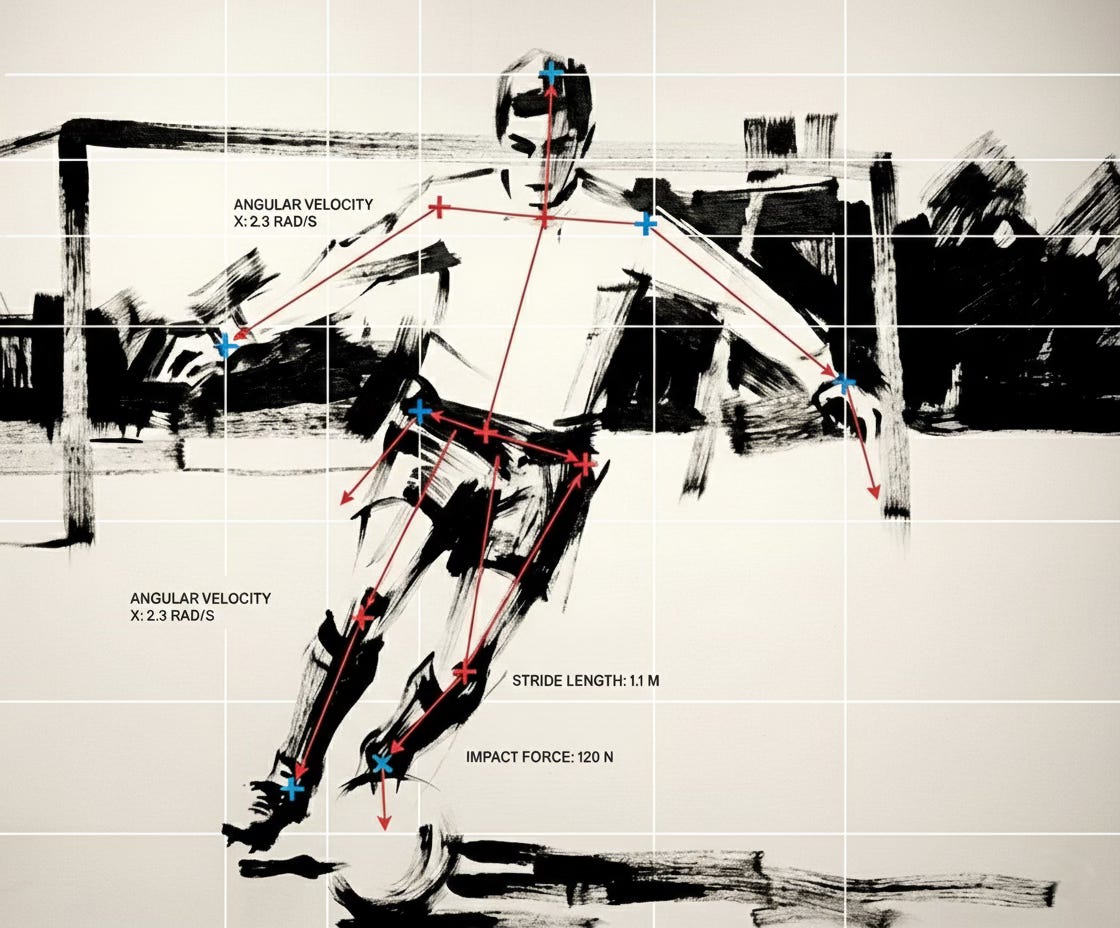
Football offers a surprisingly rich archive of strategic thinking. There is a peculiar irony in the story of Osvaldo Zubeldía, the Argentine football tactician who, in the late 1960s, systematically dismantled the romantic notion that football was an art form. His Estudiantes de La Plata side were drilled relentlessly in their training base at City Bell, subjected to 120 different tactical repetitions designed to “exclude coincidence”. They won everything there was to win [1]. Three consecutive Copa Libertadores titles. The Intercontinental Cup. The first professional championship for a “small” club in Argentine history. By any measurable standard, it was an astonishing success. And yet, as Jonathan Wilson notes, the movement Zubeldía created “provoked a profound national neurosis” about football’s very purpose [1].
The parallels to contemporary design culture are not merely illustrative; they are structural. What Zubeldía pioneered in football was a totalizing systems approach that prioritized measurable outcomes over aesthetic expression. The same approach has become the dominant ideology of modern product development, marketing strategy, and organizational design. We have built our own City Bell training facilities, populated them with tactical analysts, and subjected every creative decision to the laboratory method. Design thinking by directive. And like Argentina after 1969, we are discovering that technical virtuosity and joylessness are not mutually exclusive.
Thanks for reading The Spotted Ape! Subscribe for free to receive new posts and support my work.
The Seduction of the System
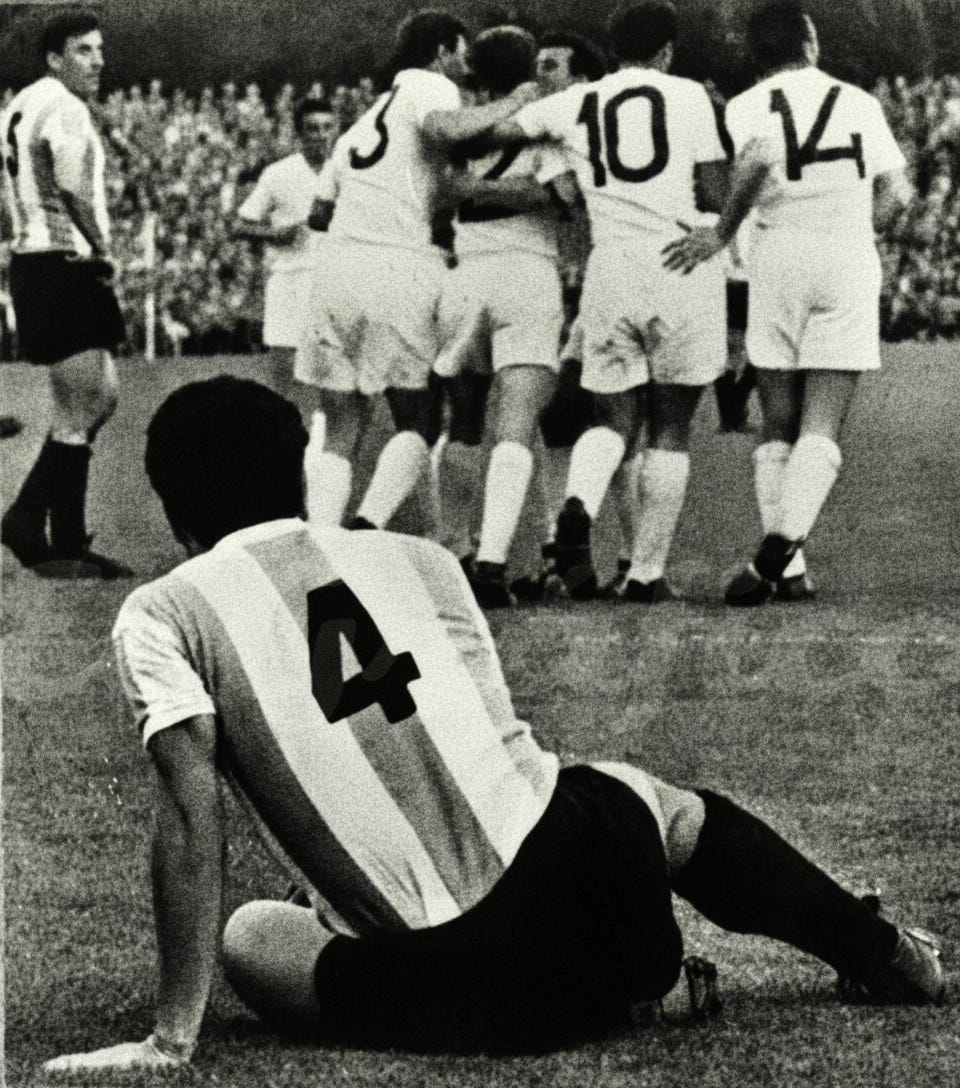
To understand Zubeldía’s achievement, one must appreciate the context from which it emerged. Argentine football in the 1950s was defined by la nuestra—“our way”—a style predicated on individual brilliance, the gambeta (dribble), and the romantic ideal of the pibe, the street urchin whose natural genius needed no formal instruction [1]. It was beautiful. It was celebrated. And in Helsingborg in 1958, when Czechoslovakia demolished Argentina 6–1 at the World Cup, it was revealed as catastrophically insufficient.
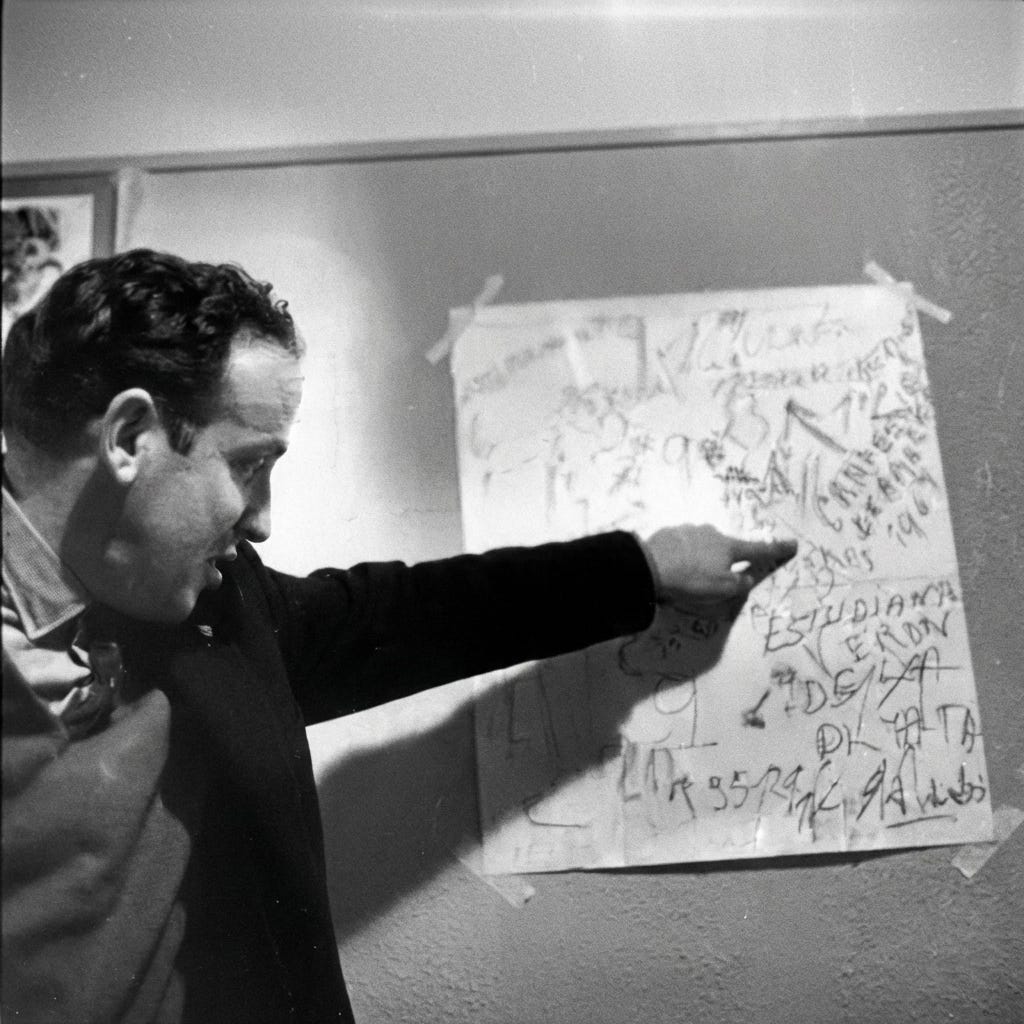
Zubeldía’s response was radical in its clarity: if the bohemian approach had failed, then bohemianism itself must be eliminated. What followed was the first truly modern technocratic intervention in South American football. Players were sequestered at the concentración, isolated from the distractions of family and nightlife. Training became laboratory work: systematic drilling of offside traps, pressing patterns, and set-piece routines until every scenario had been anticipated and optimized [1], [2]. The individual was reconceived not as an artist but as a “functional unit” within a larger system.
It worked brilliantly. Between 1967 and 1970, Estudiantes broke the monopoly of Argentina’s “Big Five” clubs, proving that disciplined systems thinking could overcome superior individual talent [1]. Zubeldía had demonstrated something profound. He showed that football, or indeed any complex endeavor, could be approached as an engineering problem, decomposed into its constituent elements, optimized through repetition, and executed with mechanical precision.
The design world has spent the last two decades learning precisely the same lesson. We have our own concentraciones now—the design systems, component libraries, and rigorous process frameworks that promise to eliminate the chaos of creative whimsy. We have our tactical drills: A/B tests, conversion funnels, growth hacking playbooks. We track our metrics with the devotion of Zubeldía’s assistant analyzing opponent set pieces. And the results, measured in quarterly growth rates and user engagement statistics, often validate the approach.
The Price of Optimization
But here is where the story becomes uncomfortable. Zubeldía’s system did not merely prioritize results; it actively suffocated the very qualities that had made Argentine football culturally significant. The gambeta was dismissed as unnecessary risk. Individual flourish was systematically coached out. As Wilson observes, Zubeldía’s philosophy was that “the match has to be won, and that’s the end of it” [1], [3], [4]. Football became not an expression of joy or identity but a zero-sum competitive exercise, stripped of aesthetic considerations.
The infamy of anti-fútbol derived not simply from its effectiveness but from its willingness to weaponize everything in service of victory. Zubeldía’s players studied opponents’ private lives to engineer psychological provocations. They mastered the “black arts” of time-wasting and referee manipulation. During the notorious 1969 Intercontinental Cup final—the “Battle of La Bombonera”—the violence became so extreme that several Estudiantes players were sentenced to prison for “disgracing a public spectacle” [1]. The system had optimized for winning so thoroughly that it had eliminated any consideration of how the victory was achieved.
This is the central paradox that contemporary design culture has yet to adequately confront. Our systems thinking, our frameworks and methodologies, our obsession with measurable outcomes, these are not value-neutral tools. They are, like Zubeldía’s tactical approach, inherently ideological. They embed certain assumptions about what matters and what can be sacrificed. And increasingly, what we sacrifice is the very dimension that creates emotional resonance and cultural significance.
Consider the contemporary obsession with “frictionless” user experiences. The term itself is revealing: friction is inherently negative, something to be optimized away. And yet friction—the slight difficulty, the unexpected detour, the moment of genuine surprise—is often where meaning emerges. As Rory Sutherland has argued, much of what makes products and experiences valuable operates at the level of the irrational, the symbolic, the psychologically resonant [5]. Strip away the friction in pursuit of efficiency, and you risk creating something technically flawless but emotionally inert.
The Metrics Trap
The problem intensifies when systems thinking intersects with measurement culture. Zubeldía’s laboratory approach was predicated on the belief that football could be decomposed into quantifiable elements: pass completion rates, territorial control, set-piece conversions. If you optimized these variables, victory would follow. The logic was impeccable. The results were undeniable. And the football was, by common consensus, unwatchable[3].
Modern design organizations have embraced a strikingly similar philosophy. Every interaction can be measured. Every design decision can be A/B tested. Every user journey can be optimized for conversion. The data, we are told, will reveal the truth. And indeed, the data often does reveal something—usually that the version with the larger call-to-action button performs 2.3% better in driving clicks.
What the data categorically cannot reveal is whether anyone actually wants to click that button, or whether the experience of doing so generates any positive emotional association with the brand. Nor can it capture the slow erosion of trust that occurs when users realize they are being relentlessly optimized. The metrics tell us that the system is working. They cannot tell us whether the system is worth operating.
This is the laboratory fallacy in its purest form: the belief that if we can measure it, we can optimize it, and if we can optimize it, we have improved it. Zubeldía measured territorial control and won matches. He could not measure—and therefore did not optimize for—the fact that his football had become so cynical that the Argentine government felt compelled to imprison his players to preserve national dignity [1].
The design equivalent manifests in products that are technically sophisticated but spiritually deadening. Everything works. Nothing delights. The buttons are perfectly sized according to Fitts’s Law. The color palette has been validated through preference testing. The copy has been optimized for reading grade level and sentiment analysis. And somehow, despite all this rigor, the experience feels like it was designed by a committee of actuaries.
When Systems Eat Creativity
There is a deeper problem embedded in systems-driven approaches: they privilege reproducibility over inspiration. Zubeldía’s genius, if we can call it that, lay in creating a framework that could turn mediocre players into a championship-winning collective. The system was the star. Individual brilliance became not merely unnecessary but actively discouraged as a source of unpredictability [1], [4].
Contemporary design organizations have embraced this logic with remarkable enthusiasm. We build design systems to ensure consistency. We create component libraries to enable “anyone” to design. We establish approval workflows to guarantee that nothing ships without proper review. The intention is admirable: to democratize design, to scale quality, to prevent the chaos of uncoordinated individual efforts.
But the effect, often unintended, is to create what might be termed “design by committee”—or worse, design by automated constraint. When every decision must fit within the system, when every component must be drawn from the approved library, when every interaction must follow the established pattern, what emerges is technically competent but creatively inert. The rough edges are sanded away. The unexpected flourishes are eliminated. What remains is professional, consistent, and profoundly boring.
This is not an argument against systems or process; both are necessary for any organization operating at scale. But it is an argument against the dangerous belief that systems alone are sufficient. Zubeldía’s training drills were valuable. His tactical innovations in pressing and spatial control were genuinely pioneering [2]. But the moment he convinced himself that football could be reduced entirely to these elements,he created something technically effective and aesthetically repellent.
The Behavioural Critique
This brings us to what might be called the behavioral critique of hyper-rationalized design. Rory Sutherland, the advertising executive and behavioral scientist, has spent much of his career demonstrating that human value perception is fundamentally irrational [5]. We prefer wine that costs more, not because it tastes better, but because the price signals quality. We find experiences more memorable when they involve mild inconvenience. We trust brands that embrace a degree of human imperfection over those that present themselves as flawlessly automated.
The implications for design are profound. If value is created not through rational optimization but through psychological resonance, then our systematic approach to eliminating irrationality is systematically eliminating value. This is not a bug in human cognition that better systems can fix; it is a fundamental feature of how meaning is constructed.
Consider the difference between Amazon’s checkout process—optimized to the point of being almost pre-conscious ritual, and the ritual of buying something from a small, well-curated shop. The former is objectively more efficient. The latter creates a memory. Amazon has optimized for conversion. The small shop has optimized for experience. These are not the same thing, and increasingly, they are inversely correlated.
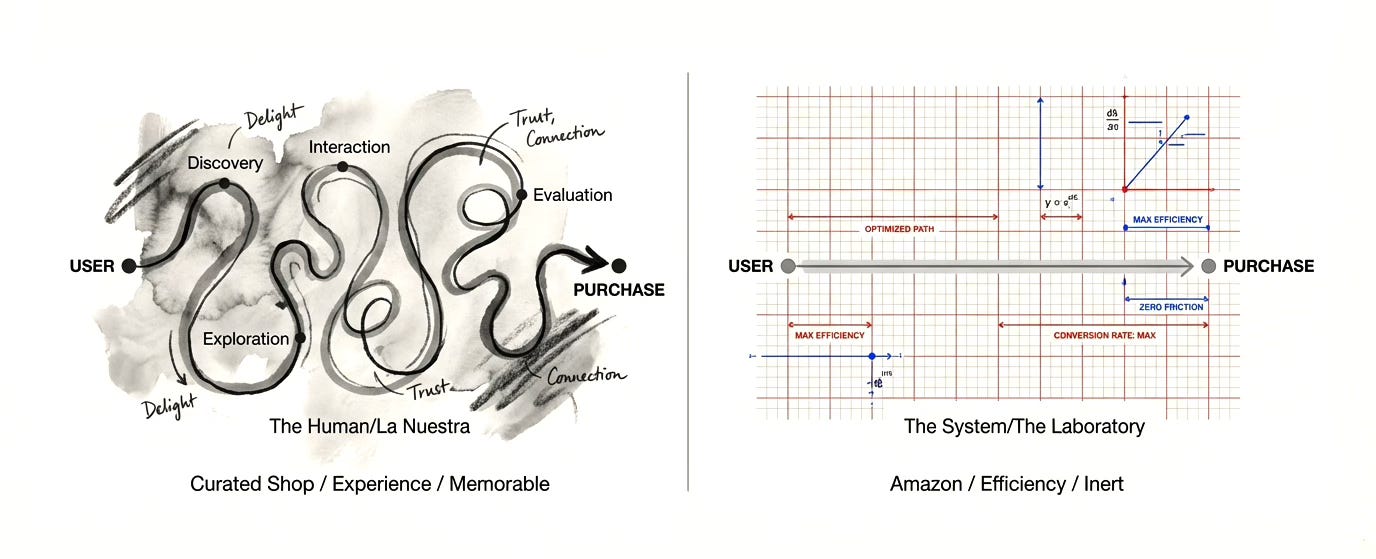
Zubeldía faced an identical trade-off. He could optimize for winning, or he could optimize for the experience of watching football. He chose winning. Argentine football culture spent the next five decades wrestling with whether that was the right choice [1], [4]. The fact that the debate continues suggests that efficiency and excellence are not synonyms.
The 1958 World Cup Trauma Response
There is a psychological dimension to this story that merits examination. Zubeldía’s radical systematization was not born from pure tactical innovation; it emerged from trauma. The 1958 World Cup humiliation shattered Argentina’s confidence in la nuestra, creating what Wilson describes as a “vacuum of self-confidence” [1]. Into that vacuum stepped a totalizing ideology that promised certainty through control.
The contemporary design world exists in a similar post-traumatic state. The dot-com crash, the failures of waterfall development, the costly disasters of undisciplined creative chaos—all of these created a cultural demand for systems that could prevent future catastrophes. And so we built them: agile frameworks, design thinking methodologies, lean startup principles. Each promising that if we followed the process, we could eliminate the risk.
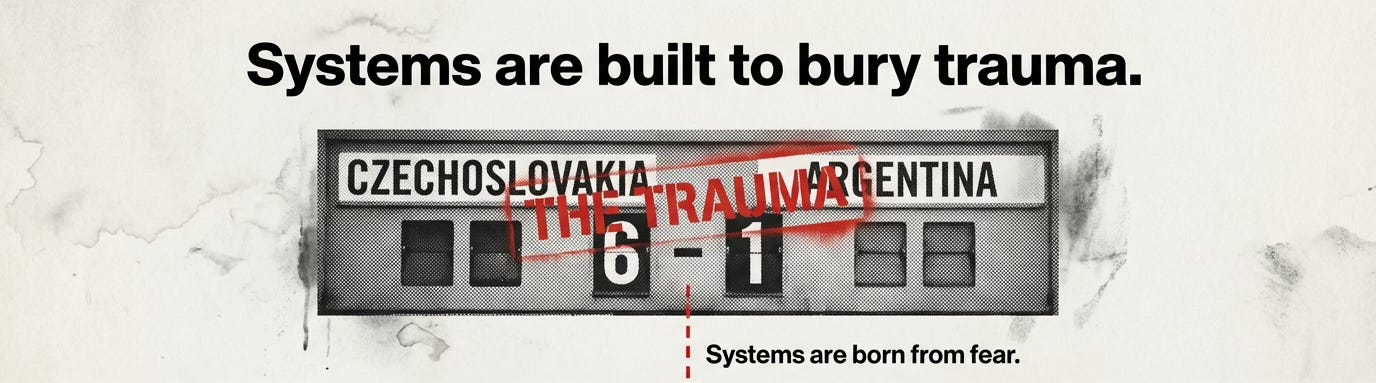
But systems built from fear tend toward authoritarianism. They are less concerned with enabling excellence than with preventing failure. And there is a world of difference between these goals. Preventing failure creates reliability. Enabling excellence creates possibility. The former is necessary. The latter is transformative. Confuse them at your peril.
Zubeldía prevented failure magnificently. His teams almost never lost. But they also almost never transcended. They did not inspire. They did not create moments of genuine beauty. They won, consistently and joylessly, until the watching public decided that winning on those terms was not worth the cost [1].
Generative AI: The Ultimate Anti-Fútbol
And now, just when design culture might have begun to reckon with these tensions, we face what may be Zubeldía’s apotheosis: generative AI. If anti-fútbol represented the reduction of football to optimizable variables, large language models and image generators seem to represent the complete automation of that reduction. From a corporate strategy standpoint this is the long-sought system that needs no pibe, no individual genius, no inspired deviation. Just patterns, probabilities, and the remorseless optimization of training data.
The parallels are almost too perfect. Zubeldía’s tactical repetitions find their digital heir in models trained on billions of examples to exclude uncertainty. His systematic drilling of set pieces finds its home in the fine-tuning of prompts. His reconception of players as “functional units” reaches its logical conclusion where the creative human is eliminated entirely, replaced by a statistical model of creativity itself.
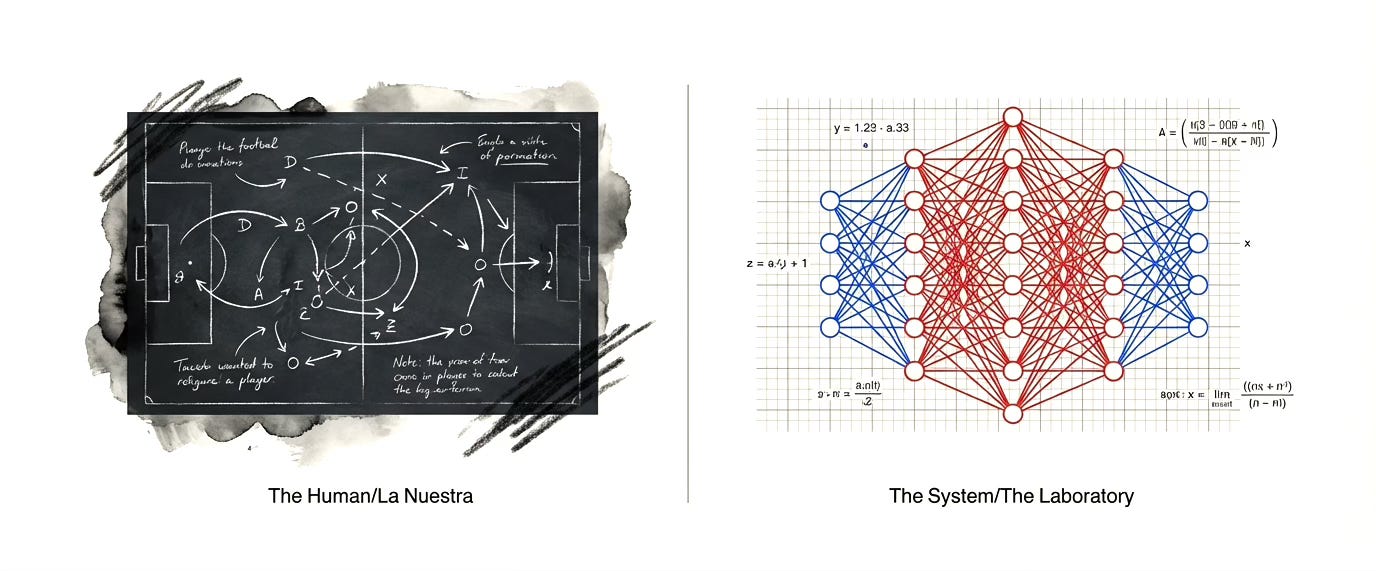
The technology is remarkable, undeniably. It can generate competent designs in seconds, write passable marketing copy, produce images that would have required hours of human labour. And like Estudiantes in 1968, it wins by conventional metrics. Faster. Cheaper. More scalable. The laboratory method perfected.
But here is what should give us pause: generative AI is, by its nature, incapable of understanding why certain patterns work. It knows that certain color palettes tend to increase engagement, that certain headline structures generate clicks, that certain visual compositions test well. What it categorically cannot know is whether those patterns create meaning, whether they build trust, whether they contribute to or erode the cultural resonance that makes a brand or product genuinely valuable. It is optimizing, brilliantly and ceaselessly, for the measurable. And it cannot even conceive of what it might be missing.
This is not an argument against the technology. It is an argument that generative AI makes design strategy more essential, not less. Because if machines can now execute the tactical repetitions with perfect efficiency, the question of which tactics to deploy, what we are optimizing for, and why certain outcomes matter over others becomes the entire game. The laboratory can now run itself. But laboratories, as Zubeldía demonstrated, optimize for what they are told to optimize for. They cannot question whether winning matches is worth the moral compromise. They cannot recognize when technical success has become cultural failure.
The danger, then, is not that AI will replace designers—though it will certainly transform the profession. The danger is that we will use it to scale anti-fútbol to previously unimaginable proportions. That we will deploy it to A/B test every pixel, to optimize every word, to remove every inefficiency, every friction, every moment of human imperfection. That we will, in other words, use the most powerful tool ever created for pattern optimization to systematically eliminate precisely the elements that create meaning.
If we learned nothing from Zubeldía, we will treat generative AI as the ultimate tactical system—a way to finally, completely, exclude coincidence from creative work. We will prompt it to make things “more engaging,” “more converting,” “more efficient.” And it will deliver, magnificently. And in five years, we will look around at a digital landscape that is technically flawless and emotionally deadening, and wonder how we got here.
Finding the Balance
So where does this leave us? Are we to conclude that systems thinking is inherently destructive, that all process is creative death, that we should return to the bohemian chaos of pure intuition? That would be as naïve as Zubeldía’s opposite error: the belief that all art can be reduced to engineering.
The answer, surely, lies in understanding what systems are for—and this becomes more critical, not less, in the age of generative AI. Systems should create the conditions for creativity, not eradicate it. They should provide structure within which inspiration can flourish, not replace inspiration with mechanical execution. Zubeldía’s tactical innovations, his pressing patterns, his spatial control principles, were genuinely valuable [2]. The problem emerged only when he convinced himself that these innovations obviated the need for the gambeta, for individual brilliance, for the unpredictable joy of the pibe. Today, we risk making the same error at machine speed and global scale.
The best design organizations understand this balance. They build systems robust enough to ensure consistency but flexible enough to permit deviation. They measure outcomes rigorously while acknowledging that not everything valuable can be measured. They optimize for efficiency while preserving space for the inefficient flourish that creates emotional connection. And crucially, they understand that generative AI is a tool that amplifies whatever philosophy guides its use—whether that philosophy prioritizes pattern completion or meaning creation, optimization or resonance, efficiency or excellence.
This is harder than either pure systematization or pure chaos. It requires the discipline to build frameworks and the wisdom to know when to ignore them. It demands both the analytical rigor to decompose problems and the creative courage to resynthesize them into something that transcends mere function. It accepts that sometimes the most important outcomes—trust, delight, cultural resonance—emerge from precisely the elements that resist optimization.
When Beauty Struck Back
Argentine football eventually found its answer to Zubeldía. In 1974, César Luis Menotti became national team coach and initiated what became known as the menottista restoration: a deliberate return to la nuestra, to individual expression, to the belief that football should be beautiful as well as effective [1], [2]. Menotti’s Argentina won the 1978 World Cup playing football that was recognizably Argentine, that celebrated rather than suppressed individual talent, that understood victory and joy need not be mutually exclusive.
The tension between beauty and pragmatism continues to define Argentine football. And crucially, Argentina has won World Cups under both approaches. The country has never settled on one as definitively superior. Instead, it has learned to hold both in productive tension, recognizing that each has validity and neither has all the answers [4].
Design culture would do well to embrace a similar ambivalence. There are contexts where Zubeldía’s approach is not merely justified but necessary. When building critical infrastructure, when establishing baseline functionality, when creating the foundations upon which creativity can build—systematic rigor is essential. Generative AI will make this systematic work more efficient than ever. But when the goal is to create something that resonates, that delights, that generates the kind of emotional connection that transforms users into advocates—then the laboratory method becomes a cage, and AI becomes the lock.
The question is not whether to embrace systems or reject them, but rather when each approach is appropriate and how to prevent either from becoming totalizing. Zubeldía’s error was not that he systematized football; it was that he convinced himself systematization was sufficient. Our error, increasingly, is making the same mistake. And now we have tools that can systematize at a scale and speed that would have astonished even Zubeldía. Which makes the strategic question of what to systematize and why more essential than ever.
The Limits of Optimization
Late in his career, after the scandals and imprisonments, after Argentine football had collectively decided that anti-fútbol represented a moral dead-end, Zubeldía reportedly said: “You don’t arrive at glory through a path of roses” [1]. It was meant as a defense, a reminder that victory requires sacrifice. But it inadvertently revealed the philosophical poverty at the heart of his project. If the path to glory involves eliminating everything that makes the journey worthwhile, perhaps glory itself has been misconceived.
This is the question that contemporary design culture must confront, and with generative AI, must confront urgently. We have optimized brilliantly. Our systems work. Our metrics improve. Our processes scale. Our AI can now execute those processes with superhuman efficiency. And yet there is a growing sense—difficult to quantify, impossible to A/B test—that we are optimizing toward a local maximum, that we have mistaken efficiency for excellence, that we are winning matches while losing something more fundamental.
The laboratory method can decompose a problem, identify inefficiencies, and engineer solutions. Generative AI can do this faster than any human ever could. What it cannot do—what it is structurally incapable of doing—is generate meaning. Meaning emerges from the inefficiencies, the human imperfections, the moments of inspired deviation from the plan. It emerges when designers trust their instincts over the data, when organizations permit experiments that cannot be pre-justified by metrics, when products embrace friction because friction creates the possibility of genuine surprise. These are precisely the elements that AI, optimizing for pattern completion, will systematically remove.
Zubeldía won his trophies. His system worked, by every measurable standard. And fifty years later, Argentine football remembers him primarily as a cautionary tale, as proof that you can optimize so thoroughly for success that you forget why success was worth pursuing in the first place. The real question for contemporary design is whether we will learn that lesson before we deploy the most powerful optimization engine ever created. Or whether we will need our own Battle of La Bombonera—a digital landscape so technically perfect and so spiritually vacant that we are forced, finally, to reckon with what we have built.
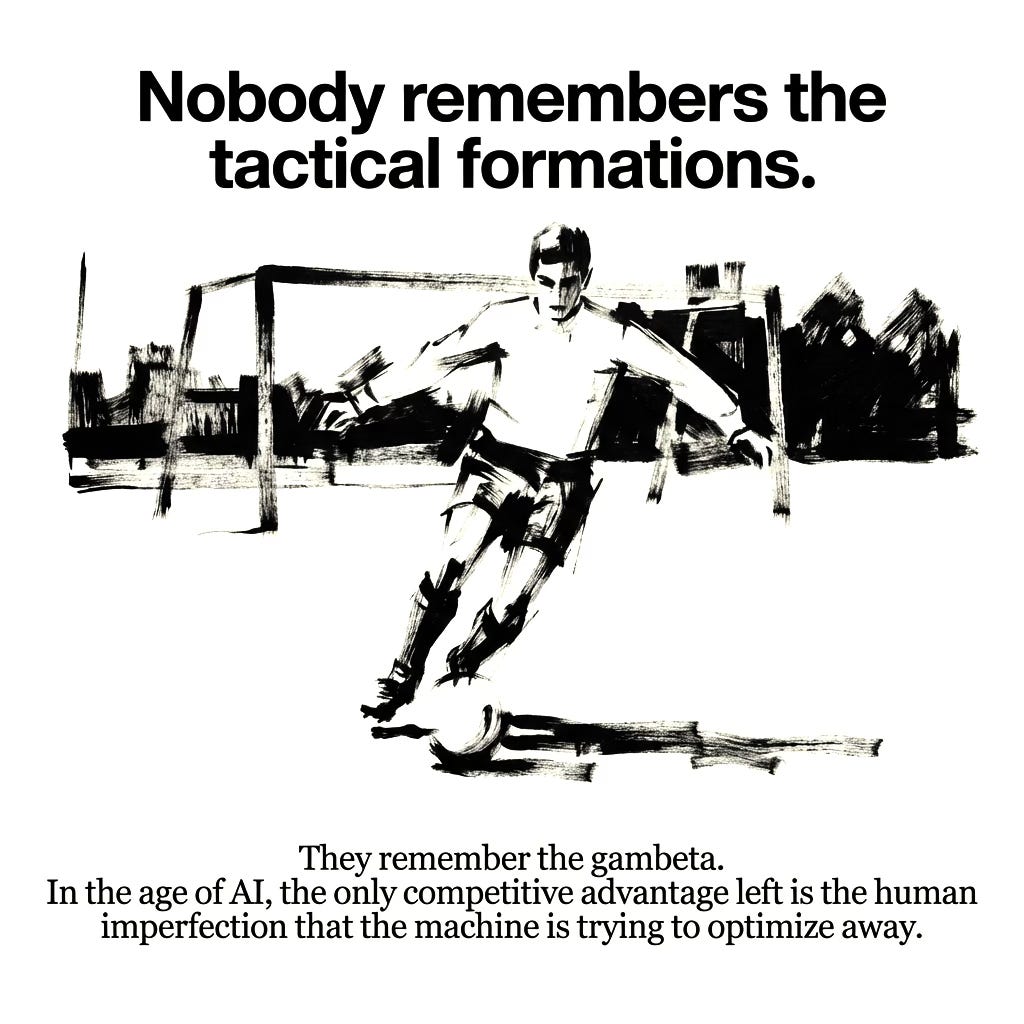
The choice, as always, is not between systems and creativity, between measurement and intuition, between Zubeldía and Menotti, between AI and human designers. The choice is whether we can hold both in productive tension, whether we can build frameworks that enable rather than constrain, whether we can use our most powerful tools to create space for human flourishing rather than eliminate it. Because in the end, nobody remembers the tactical formations. They remember the gambeta. They remember the moment of individual genius that transcended the system. They remember, in other words, exactly what Zubeldía spent his career trying to eliminate—and exactly what generative AI, if deployed without strategic wisdom, will eliminate at scale.
References
[1] J. Wilson, Angels with dirty faces: The footballing history of Argentina. Orion, 2016.
[2] J. Wilson, Inverting the pyramid: The history of football tactics. PublicAffairs, 2013.
[3] O. J. Zubeldía and A. Geronazzo, Táctica y estrategia del fútbol. Jorge Álvarez Editor, 1965.
[4] J. Wilson, The barcelona legacy: Guardiola, mourinho and the fight for football’s soul. BLINK Publishing, 2018.
[5] R. Sutherland, Alchemy: The dark art and curious science of creating magic in brands, business, and life. William Morrow, 2019.
[6] Wikipedia contributors, “Disaster of sweden — Wikipedia, the free encyclopedia.” 2025. Available: https://en.wikipedia.org/wiki/Disaster_of_Sweden
Thanks for reading The Spotted Ape! Subscribe for free to receive new posts and support my work.