From Seabed to Orbit
When President Trump declared last week that acquiring Greenland represents “a national security priority” and his press secretary confirmed that “utilising the U.S. Military is always an option” [1], the pronouncement generated predictable outrage. Danish officials pushed back forcefully [2], whilst NATO allies issued stern statements about sovereignty [3]. At the same time in Svalbard, where China’s Yellow River Research Station has stood since 2004, Norway ordered the removal of symbolic stone lions from the facility’s entrance—a telling indication of how even ostensibly scientific Arctic presences have become sites of geopolitical contestation [4].
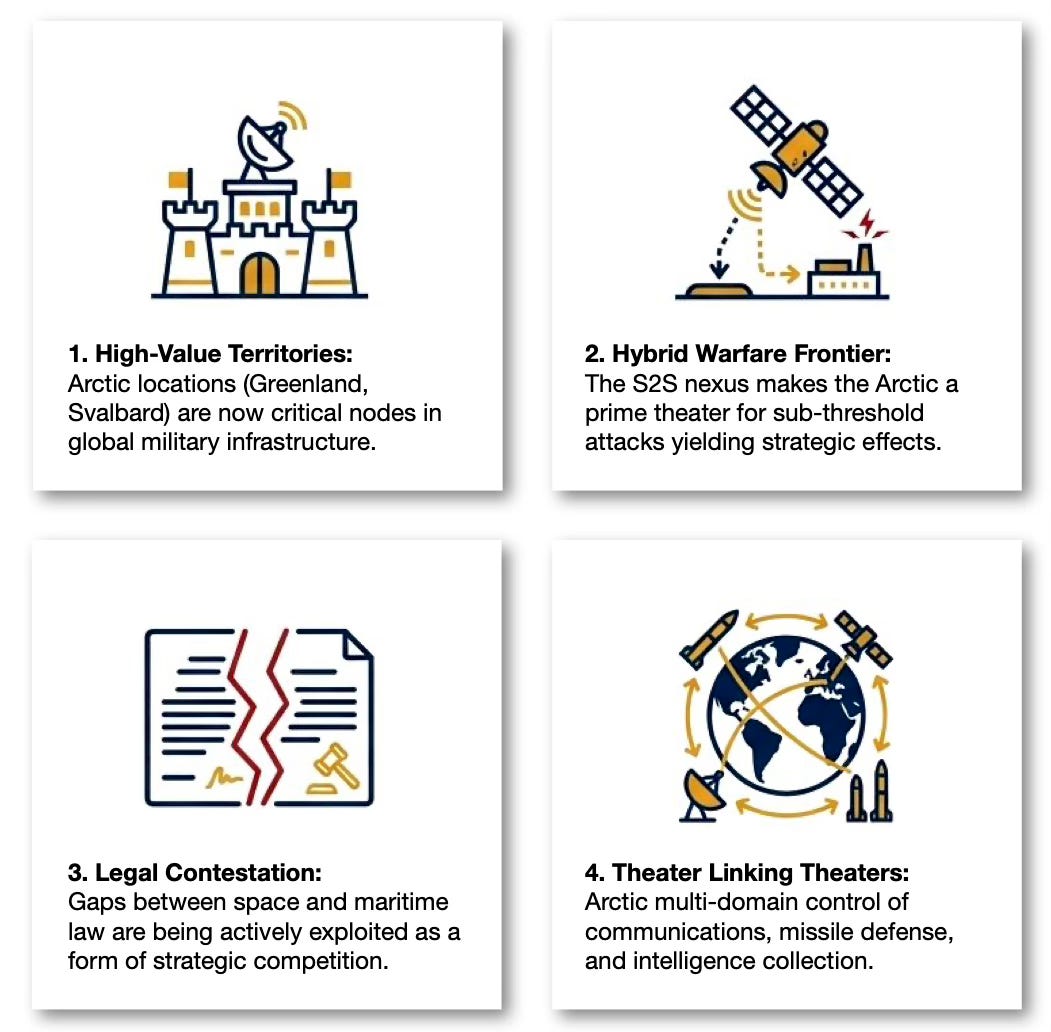
Greenland and Svalbard are critical military nodes; the S2S nexus enables hybrid operations, legal gaps are exploited strategically, and multi-domain control links communications, missile defense, and intelligence collection.
Yet, the motive might have less to do with minerals than with a technical reality: physics. The Arctic has become strategically indispensable because of the orbital mechanics that govern satellites. Whilst Trump noted that “Greenland is covered with Russian and Chinese ships” [5], the real competition is in data streams connecting the seafloor to orbit.
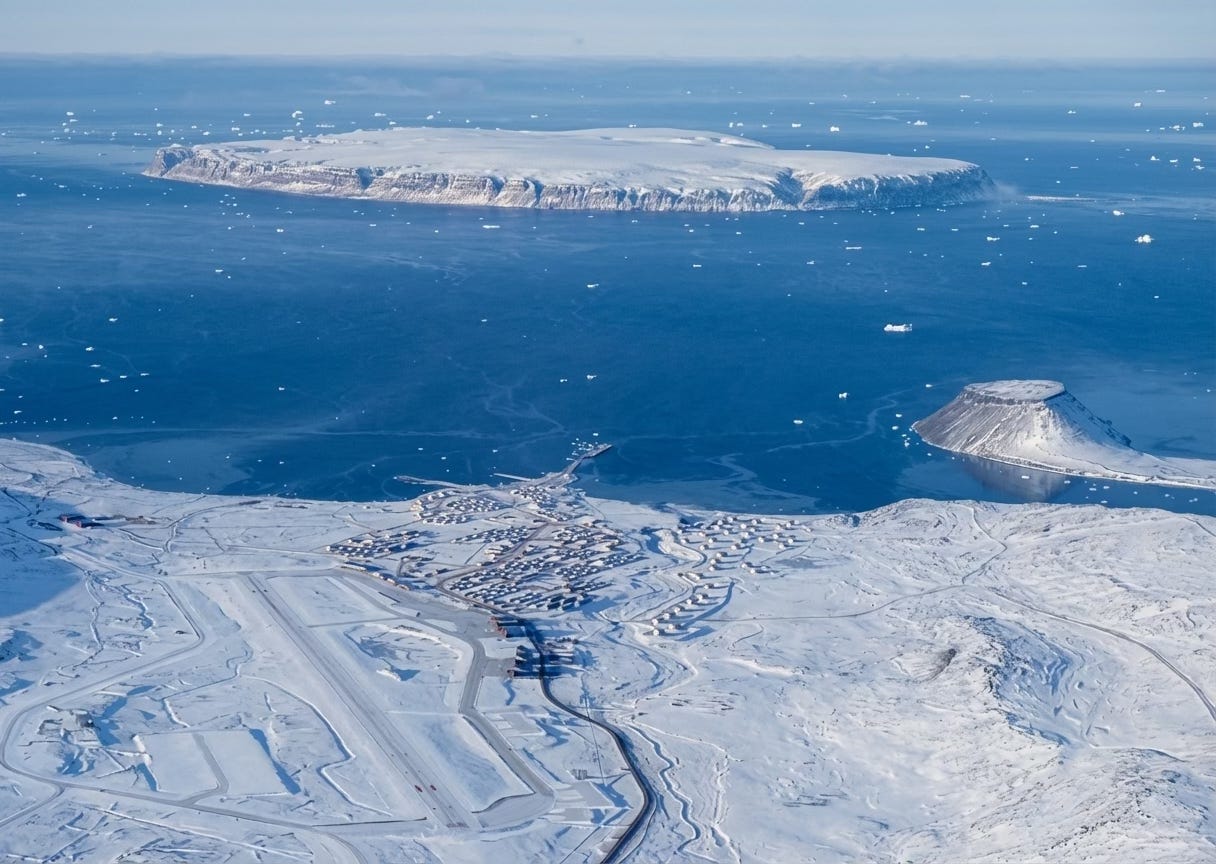
The traditional concepts of territorial sovereignty prove spectacularly ill-suited to contemporary strategic requirements. These contests do not unfold at the level of flags or borders, but in the ambiguous spaces where infrastructure, science, and strategy overlap—spaces in which presence itself has become power.
Consider a reconnaissance satellite. Polar orbits provide global coverage but converge at the poles. A ground station at 40°N might only contact a satellite three times daily [6]. In contrast, Greenland’s Pituffik Space Base at 76°N enables “14 of 14 capability”—near-continuous data collection [7].
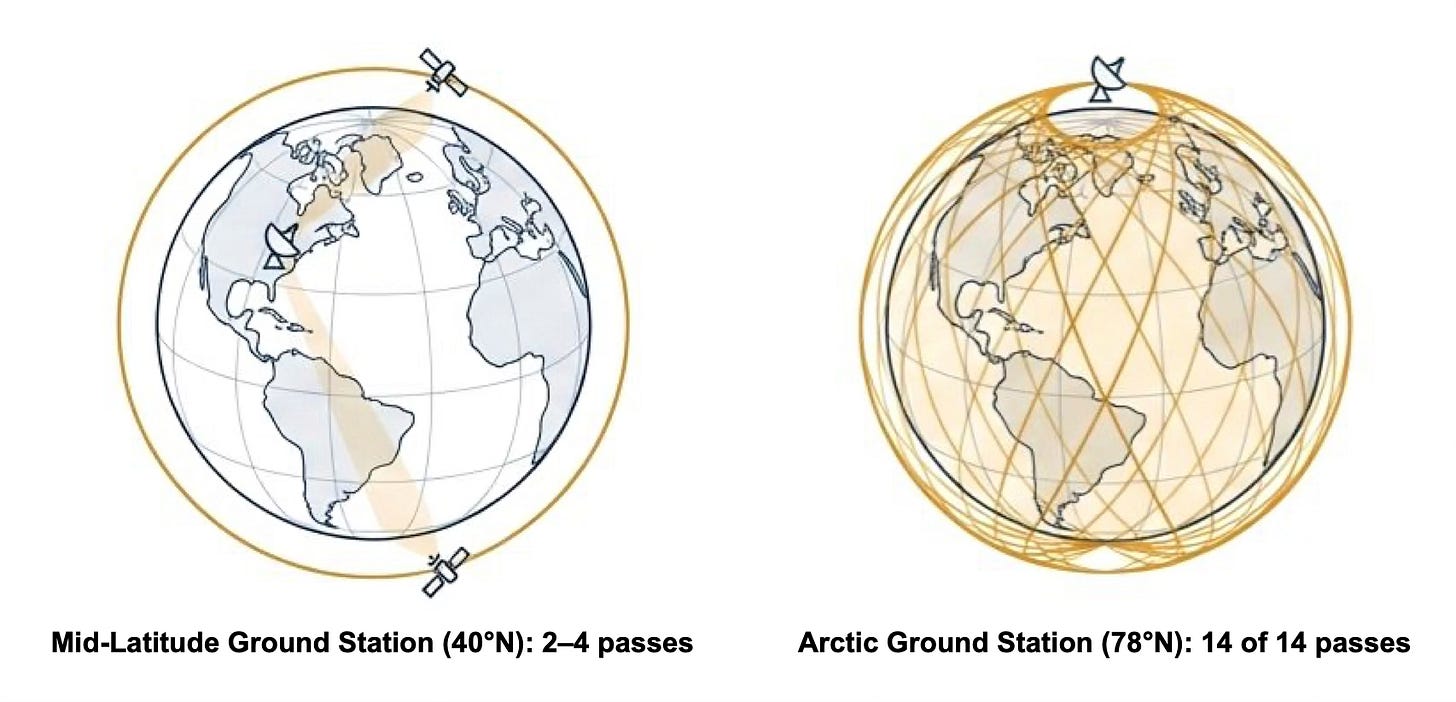
Geography asserts itself where technology cannot. The Center for Strategic and International Studies (CSIS) observes that “orbital access scarcity” is determined by location, not innovation [8]. States controlling Arctic territory control the bottlenecks of space-based intelligence.
Arctic ground stations are integrated with subsea fibre-optic cables. This creates a “subsurface-to-space nexus”: severing cables degrades orbital capabilities without touching the satellites themselves [9].
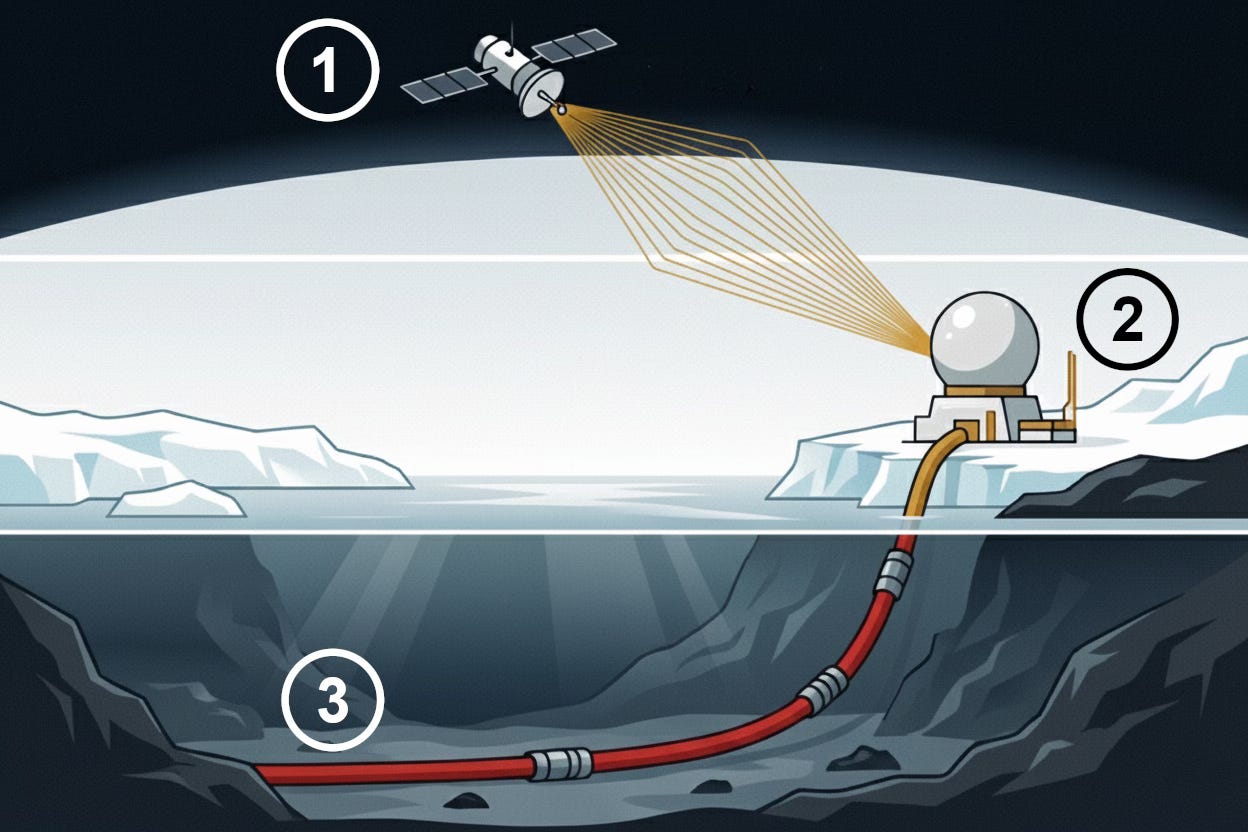 > Strategic Note: Attacks on cables preserve plausible deniability. One drags an anchor across a route, attributes it to error, and accomplishes strategic degradation below the threshold of war [8].
Recent incidents involving the Chinese-flagged Yi Peng 3 and the severance of Svalbard’s cables highlight this vulnerability [10], [11]. The Greenland-Iceland-United Kingdom (GIUK) Gap serves as both a submarine transit point and a cable concentration zone [12].
In addition, the legal framework governing the Arctic is outdated. The 1967 Outer Space Treaty and 1982 United Nations Convention on the Law of the Sea (UNCLOS) did not anticipate ground station positioning or dual-use research facilities [13], [14]. This “legal lacuna” has allowed China’s Military-Civil Fusion doctrine to flourish in scientific installations [15].
In conclusion, geography has reasserted itself. Future military power will depend on the infrastructure linking Earth to orbit [16], [17]. Control of the Arctic infrastructure (i.e. the ground stations and cables) implies controlling the connective tissue of modern power [18].
References
[1] K. Leavitt, “White house statement on Greenland,” NBC News, 2026.
[2] M. Frederiksen, “Statement on U.S. Greenland threats,” CNN, 2026.
[3] European Leaders, “Joint statement on Greenland,” Al Jazeera, 2026.
[4] T. Nilsen, “‘This decision is not likely to be appreciated by Beijing’: Two stone lions outside the door to the Yellow River Station in Ny-ålesund at Svalbard could cause turmoil for Norway–China science cooperation on Arctic.” [Online]. Available: https://www.thebarentsobserver.com/news/this-decision-is-not-likely-to-be-appreciated-by-beijing/428405
[5] D. Trump, “Remarks aboard Air Force One,” CNN, 2026.
[6] G. Falco, N. Boschetti, and I. Nikas, “Undercover infrastructure: Dual-use Arctic satellite ground stations,” CIGI Papers, no. 291, 2024.
[7] M. Lynch, “Space and defense in the high north,” Space and Defense, vol. 16, 2025.
[8] Center for Strategic and International Studies, “Addressing arctic vulnerabilities,” 2025. Available: https://www.csis.org/analysis/addressing-arctic-vulnerabilities
[9] G. Falco, “The arctic: A new high-ground battleground for space security,” CIGI Policy Brief, no. 184, 2024.
[10] A. Lott, “Conventional jurisdictional approaches to submarine cables,” International and Comparative Law Quarterly, vol. 74, no. S1, 2025.
[11] SIPRI, “A legislative route to combat sabotage of undersea cables.” 2025. Available: https://www.sipri.org/commentary/topical-backgrounder/2025/legislative-route-combat-sabotage-undersea-cables
[12] T. Hughes, “Closing the gap between Europe and North America,” High North News, 2024.
[13] UNOOSA, “Outer space treaty.” 1967. Available: https://www.unoosa.org/oosa/en/ourwork/spacelaw/treaties/outerspacetreaty.html
[14] A. L. Kahraman, “China’s digital footprint in the Arctic,” The Arctic Institute China Series 2025, 2025.
[15] Center for Strategic and International Studies, “Frozen frontiers: China’s great power ambitions,” 2024. Available: https://features.csis.org/hiddenreach/china-polar-research-facility/
[16] U.S. Department of Defense, “2024 department of defense arctic strategy,” 2024. Available: https://media.defense.gov/2024/Jul/22/2003507396/-1/-1/1/2024-DOD-ARCTIC-STRATEGY.PDF
[17] FPRI, “Protecting the north American Arctic and beyond,” 2025.
[18] K. Frazier, “Dual-use dilemma: Maritime infrastructure and the Arctic,” Ted Stevens Center for Arctic Security Studies, 2025.