Wisdom is Like a Baobab Tree
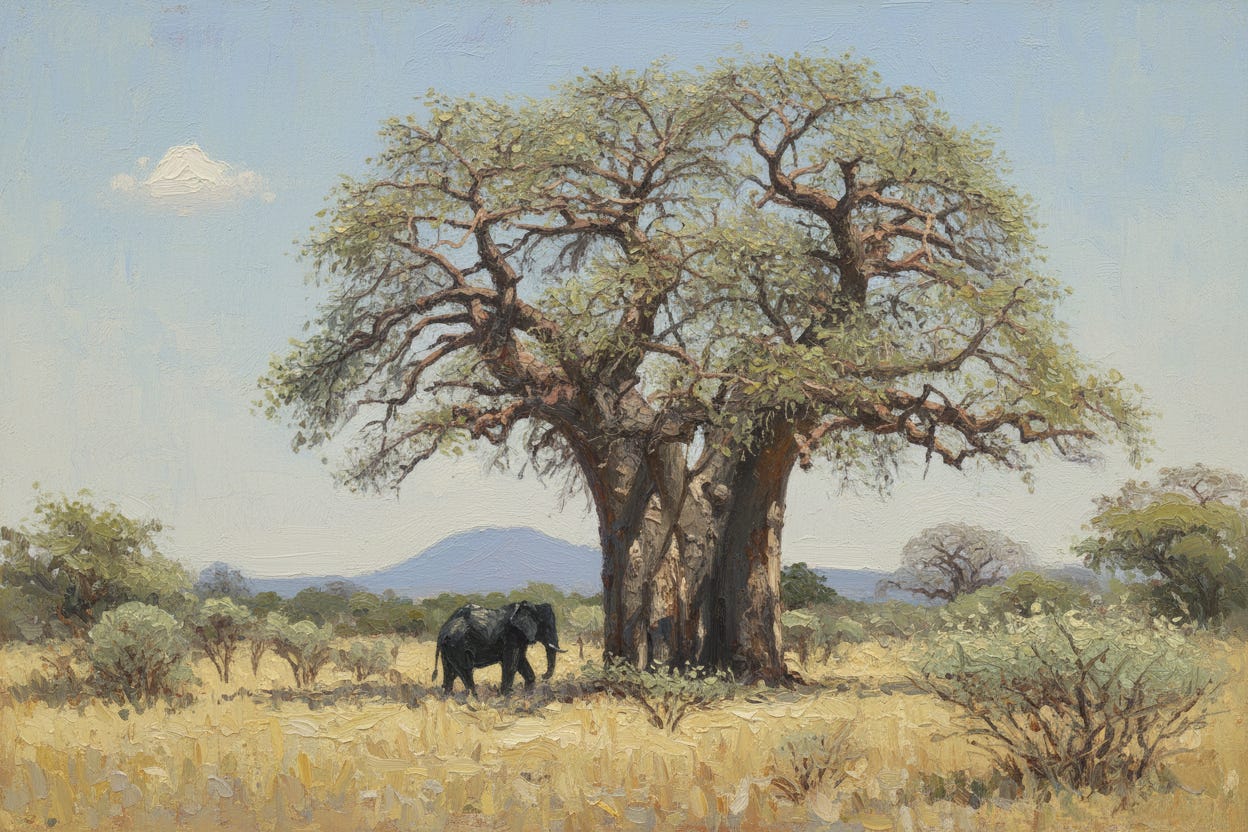
Consider the baobab (Adansonia digitata). A tree that looks as if it has been planted upside-down. A great, gnarled trunk surmounted by a tangle of branches that resemble roots clawing at the African sky. It is preposterous and magnificent. It has, for millennia, been quietly conducting a masterclass in how to live, how to know, and how to belong.
The baobab is not merely a tree. It is a metaphor for relational knowledge sytems. The Western epistemic tradition, if we can call it that, resembles a taproot system. A single root drills straight down in search of a foundational truth. It is an approach that demands uniformity, thrives on binaries (Good/Evil, Us/Them, Centre/Periphery), and has an unlovely habit of trying to colonise everything it encounters, including our ways of knowing [2]. This is the epistemology of the grid, an extractive industrial monoculture. It is linear, hierarchical, and remarkably efficient at turning living systems into resources.
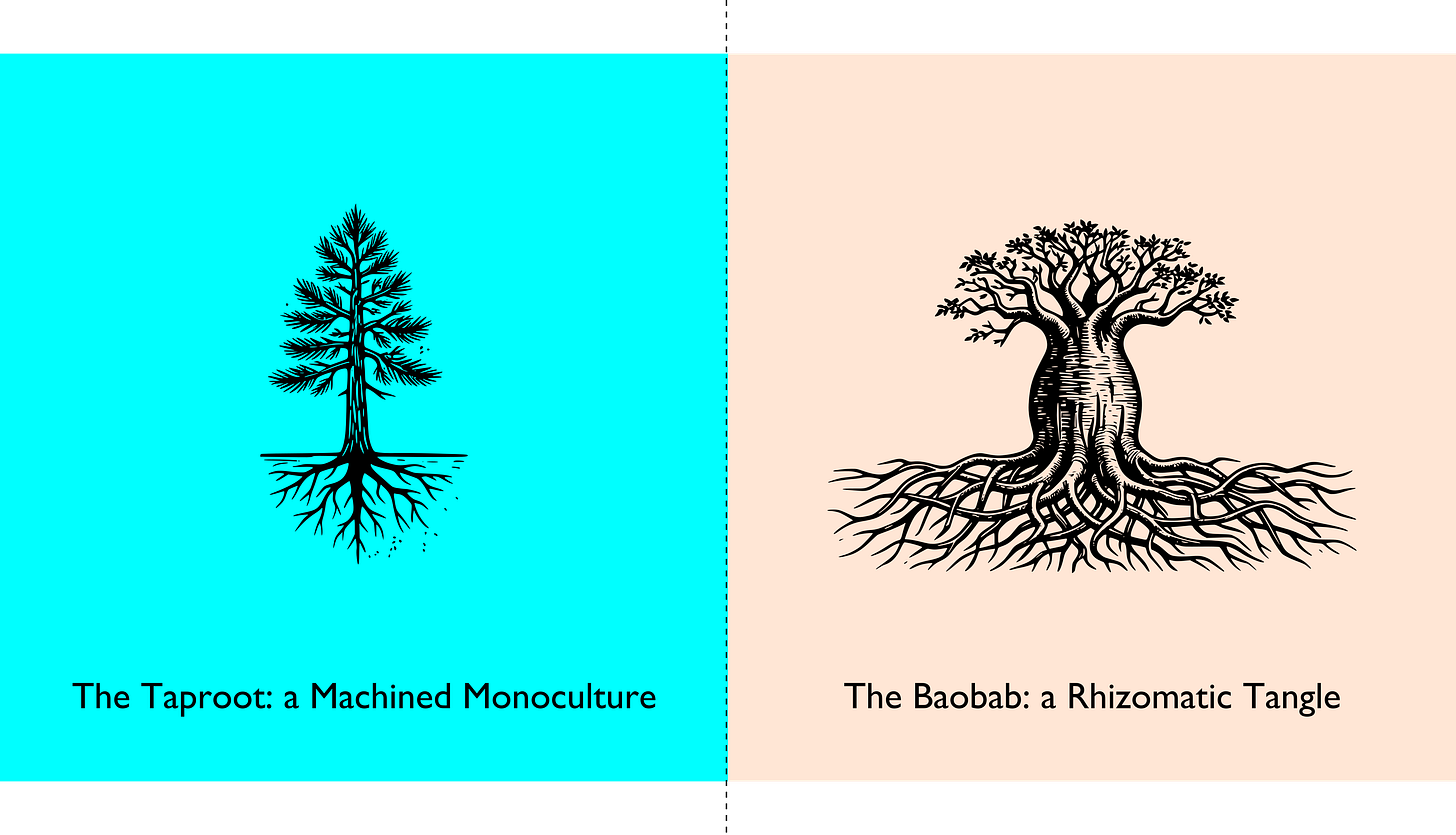
The baobab, and the African epistemologies it embodies, proposes something altogether more entangled. Its root system spreads horizontally, a rhizomatic tangle without a single centre. This, as scholars like Édouard Glissant have argued, is the model for Relation. He proposes that identity and wisdom emerges from chaos-monde - the messy, reciprocal networks of contact in life [2]. It is a wisdom of connection, not conquest. As an old Akan and Ewe proverb has it:
“Nunya, adidoe, asi metunee o”
“Wisdom is like a baobab tree; no one individual can grasp it” [2].
One cannot embrace the literal tree. Its girth can exceed eleven meters, and one cannot monopolise the wisdom it represents. It is collectively held, communally sustained.
This relational wisdom is unmistakable among the Hadza people of northern Tanzania. As one of the world’s last remaining hunter-gatherer communities, they offer a rare, continuous record of our human patterns of life. Their existence is not alongside the baobab, but within its ecological and spiritual web. The tree is their supermarket, pharmacy, hardware store, water reservoir, and cathedral. Its hollow trunks trap monsoon rains, creating natural cisterns (kesati) that the Hadza access with peg ladders [3]. Its fruit, naturally dehydrated on the branch, are pulped into a vitamin C-rich “milk”. The bark becomes rope and bowstring. The pods become cups and carriers. Bees nest in its heights, and a remarkable bird, the honeyguide, leads the Hadza to the hives in a feat of interspecies cooperation.
This deep, symbiotic adaptation treats the tree not as a resource to be extracted, but as a relation to be sustained. The Hadza even give birth within the baobab’s hollow trunks, remaining there until the umbilical cord falls away: a poignant literalisation of being born into a web of life [3]. The tree features in their creation myths as the axis along which ancestors descended from the sky. They engage with the spiritual realm associated with it, but do not worship the tree itself [3].
Our modern taproot-world has also “discovered” the baobab. It is marketed as a superfood, its pulp packed with prebiotic fibre. Ironically, this very fibre is likely a key reason Hadza gut microbiomes are the most diverse on Earth, a bastion of health that industrial diets have eroded [3]. The extractive taproot mentality now competes with the Hadza for the fruit, threatening to sever the very relational web that sustains both the people and, arguably, the trees themselves. As researchers bluntly note, “The fate of the Hadza will be the fate of their baobab trees” [3].
Here lies the dilemma. The baobab’s symbolic power is so potent it can be weaponised for opposite ends. In some political discourse, it is cast as a monstrous, obstructive state that is “damned hard to uproot” [4]. Yet in its cosmic role, it is the great provider, the tree of life.
The rhizomatic, relational wisdom embodied by the baobab and lived by the Hadza offers a corrective to our age of catastrophic bipolar thinking. It suggests that knowing is not about domination and delineation, but about connection and context. That belonging is not about purity of origin, but about the generative tangle of relationships. That a tree, a people, or an idea, can be singular in presence, yet at the same time defiantly plural in meaning.
In our monoculture of thought, obsessed with singular origins and “one best way,” the upside-down tree stands as a right-side-up challenge. Its wisdom is not owned. It is shared. It is not declared but enacted. It asks, quietly but persistently, whether we are brave enough to let go of the taproot and learn, finally, how to embrace the tangled mesh of life.
References
[1] F. Reus, “Baobab and elephant, tanzania.” Wikimedia Commons, Creative Commons Attribution-ShareAlike 2.0, 2004. Available: https://commons.wikimedia.org/wiki/File:Baobab_and_elephant,_Tanzania.jpg

[2] K. N. Ngwa, A. Cisse Niang, and A. Pressley, Eds., Life under the baobab tree: Africana studies and religion in a transitional age. Fordham University Press, 2023.
[3] J. Rashford, Baobab: The Hadza of Tanzania and the baobab as humanity’s tree of life. Springer, 2023.
[4] N. Thompson and S. Thompson, The baobab and the mango tree: Lessons about development: African and Asian contrasts. Zed Books, 2000.