The Flying Spotted Ass Ape and the Psychology of Creative Formation
Does your team have a Spotted Ape? A brightly coloured B-24 Liberator from 1943 offers a lesson for the AI age: creative mentors who can bring order to chaos with a light touch.
The Spotted Ape - also called the Flying Spotted Ass Ape - was a battered bomber splashed with polka dots, circling East Anglia like a circus act that refused to land. Too weary for combat but too useful to discard, it had one task - to gather hundreds of bombers into formation before they vanished into the fog.
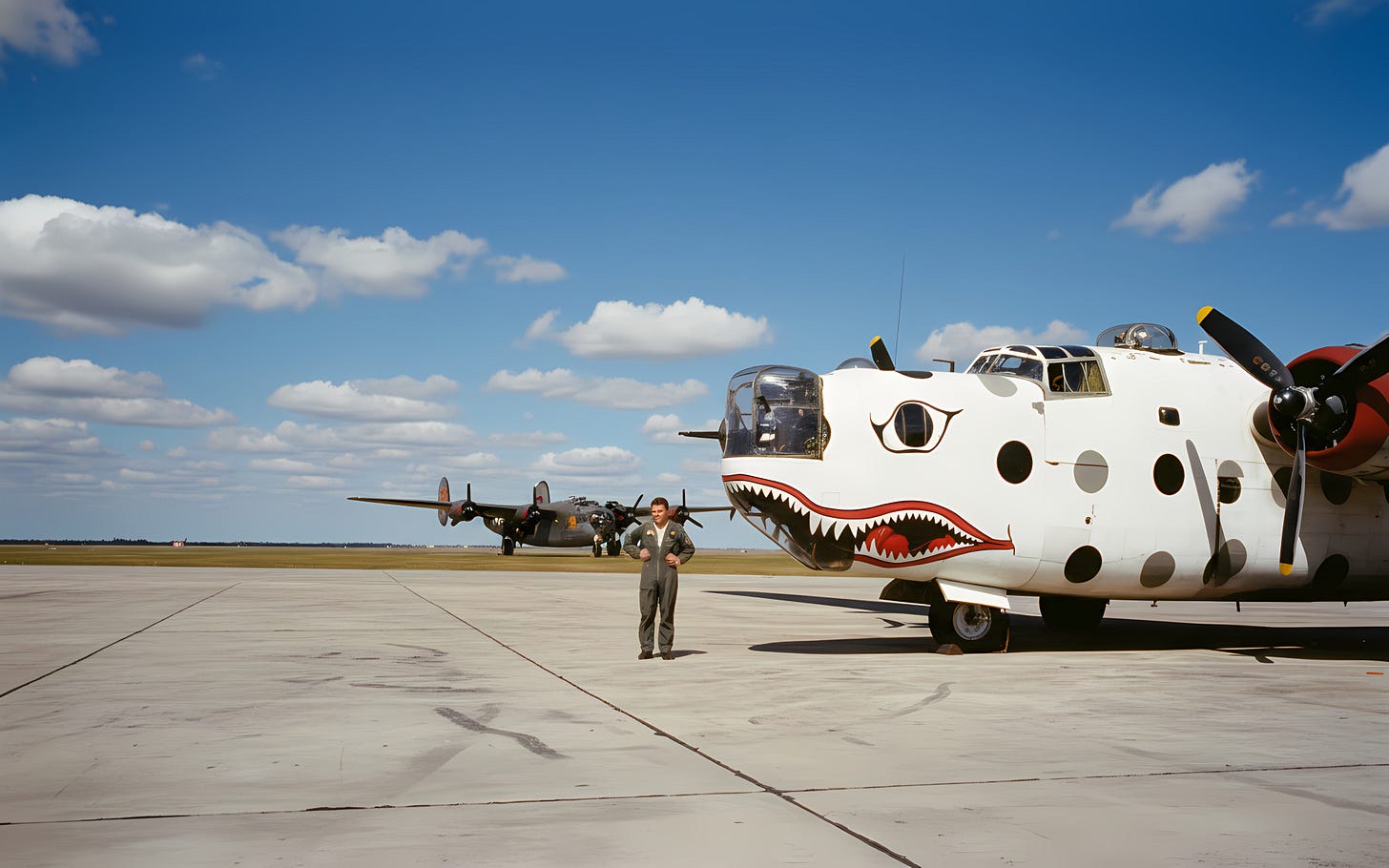
The skies over England were crowded and confused. Green crews lifted off from dozens of fields, often colliding before reaching altitude [1]. On 1 August 1943, during the raid on Ploiești, disarray in assembly and navigation cost 53 out of 177 aircraft and 310 lives [2]. The answer was absurd and brilliant: turn one old plane into a beacon [1]. Painted in clownish colours and fitted with flares, it would climb first, circle a fixed point, and signal until its flock formed [1]. When the bombers were ready, it dipped beneath the lead ship and went home [1]. The crews called it the “Judas Goat” - the guide that led others to battle but never joined the slaughter [1].
Lessons from a polka-dotted bomber
These garish aircraft became standard in late 1943 and 1944 as the Eighth Air Force expanded from a few hundred bombers to armadas of more than a thousand [1], [3]. During Big Week in February 1944, over a thousand bombers struck the German aircraft industry [4]. Similar numbers flew in the weeks before and after D-Day, hitting multiple targets [3]. By early 1945, raids on Berlin sent 1,400 bombers and nearly a thousand fighters into the air [3].
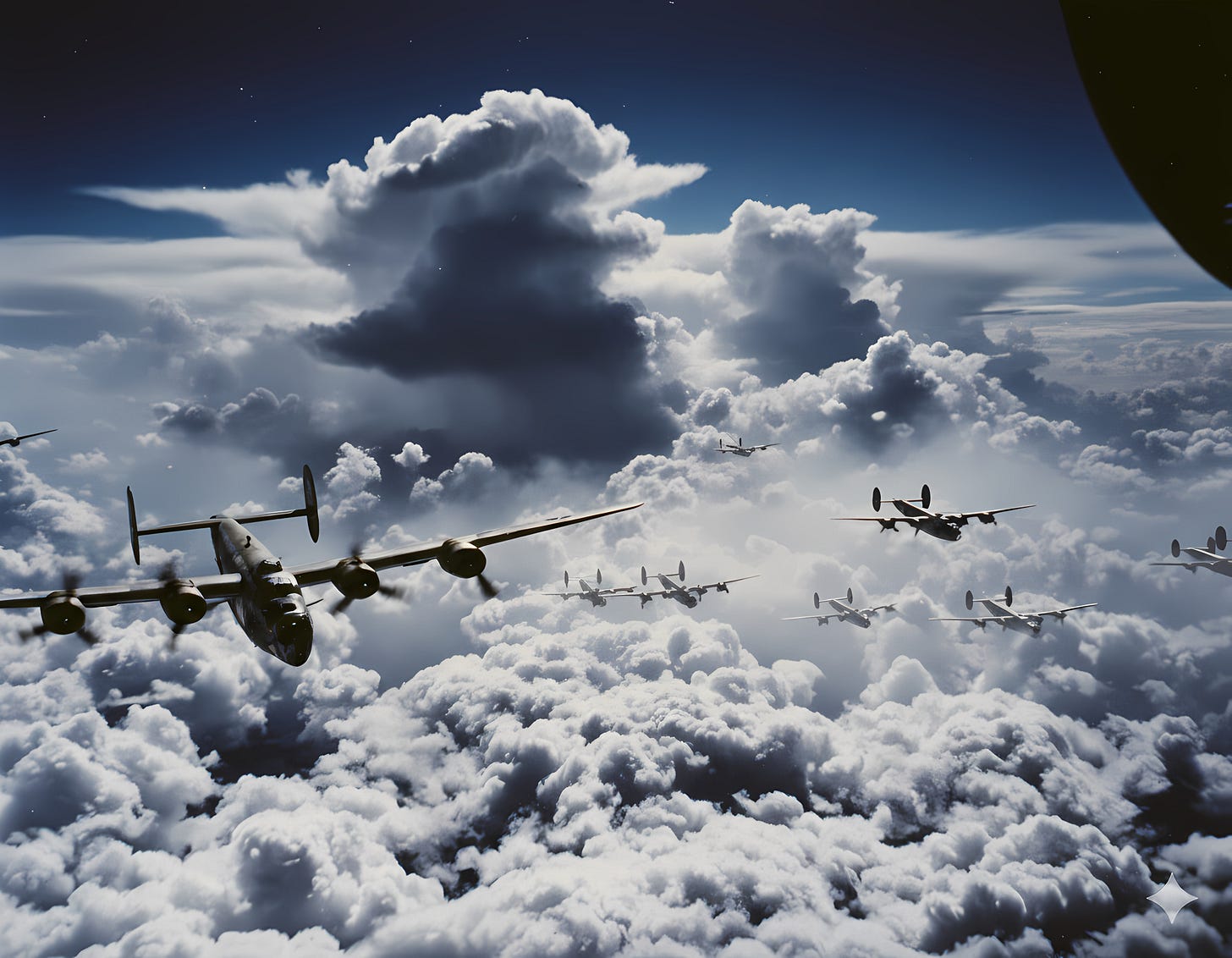
With such vast formations, order mattered more than firepower [1]. The assembly ships were not weapons but anchors. The 458th Bombardment Group at RAF Horsham St Faith had one of the most famous: the Flying Spotted Ass Ape, also known as the Spotted Ape [1]. For nearly a year, piloted by experienced crews, it guided every major mission without firing a shot [1]. The genius lay not in its technology but its psychology — visibility, credibility, and timing.
The same principles apply to modern creative teams, especially those navigating the turbulence of generative AI. Technology accelerates ideas but amplifies noise. Brilliant individuals chase their own trajectories. Deadlines loom. Meetings collide. Everyone is flying, but no one is forming. What the Spotted Ape offered in the air, creative teams now need on the ground: visible cues, calm example, practical wisdom, and the discipline to withdraw once the group finds its rhythm.
Example
Assembly ships did not command; they demonstrated. When one aircraft steadied its course, others followed. Leadership through example remains stronger than instruction [5]. When a senior creative admits uncertainty or pauses to recalibrate, it grants permission for others to do the same. Formation follows behaviour, not memos.
Experience
The Spotted Ape was flown by veterans who knew turbulence, fuel strain and fear — the feel of the craft itself. Michael Polanyi called this “tacit knowledge,” the unspoken skill that resists codification [6]. An “indwelling” of routines and shared heuristics [6]. Modern leaders often hover above the work they manage. The best still know how to fly.
Exit
Once the bombers held formation, the Spotted Ape turned home [1]. Leadership that withdraws at the right moment leaves competence behind. Leadership that lingers breeds dependence. In many AI-driven teams, constant oversight creates learned helplessness. True guidance ends in self-correction.
Deploying a modern Spotted Ape
Launching a modern Spotted Ape is about people, not platforms. Start complex projects with a seasoned guide for the first sprint — someone who reads personalities, spots friction early, and sets small rituals of alignment before the pressure sets in. Their role is to kindle autonomy, not control it. Once the rhythm holds, they step aside. Shared experiences humanise complexity. Mistakes become collective learning rather than individual blame. When these tacit rhythms take root, the team sustains itself. Research suggests that early mentorship can halve misalignment issues [7],[8]. and strengthen originality by improving idea flow and reducing relational fatigue [9].
Why it matters
As generative AI reshapes media, marketing and design, the missing ingredient is not another dashboard but a human point of orientation. AI systems automate tasks but not trust. Creative leadership today requires less algorithmic literacy and more behavioural insight. The Spotted Ape reminds us of a simple truth: the most valuable person in the digital room is rarely the fastest coder or the slickest strategist. It is the steady collaborator — the one with empathy, imagination and a calming diplomatic nature — circling just long enough for everyone else to find formation. The bombers that made it home were not the strongest. They were the ones that learnt to fly together.
References
[1] W. Wolf, Special Operations Consolidated B-24 Liberators: The Unknown Secret and Specialized Duties Aircraft. Air World (Imprint of Pen & Sword Books Ltd), 2023, p. 256.
[2] C. K. Webster and N. Frankland, The Strategic Air Offensive against Germany, 1939-1945: The History of the Second World War. in United Kingdom Military Series. London, UK: H.M.Stationery Office, 1961.
[3] D. L. Miller, Masters of the Air: America’s Bomber Boys Who Fought the Air War Against Nazi Germany. New York, NY: Simon & Schuster, 2007.
[4] J. Holland, Big Week: The Biggest Air Battle of World War II. New York, NY: Atlantic Monthly Press, 2018.
[5] R. B. Cialdini, Influence: Science and Practice, 5th ed. Pearson, 2009.
[6] M. Polanyi, The Tacit Dimension. Routledge & Kegan Paul, 1966.
[7] Juan F. Aquino, Ryan R. Riss, Susan M. Multerer, Lynn N. Mogilner, and Theresa L. Turner, “A Step-by-Step Guide for Mentors to Facilitate Team Building and Communication in Virtual Teams,” Medical Education Online 27, no. 1 (2022): article 2094529, https://doi.org/10.1080/10872981.2022.2094529. 
[8] National Academies of Sciences, Engineering, and Medicine, The Science of Effective Mentorship in STEMM (Washington, DC: National Academies Press, 2019), https://doi.org/10.17226/25568.
[9] B. W. Tuckman, “Developmental Sequence in Small Groups,” Psychological Bulletin, vol. 63, no.6, pp. 384–399, 1965.
Thanks for reading! Subscribe for free to receive new posts and support my work.