Playing in the River Before the Fire
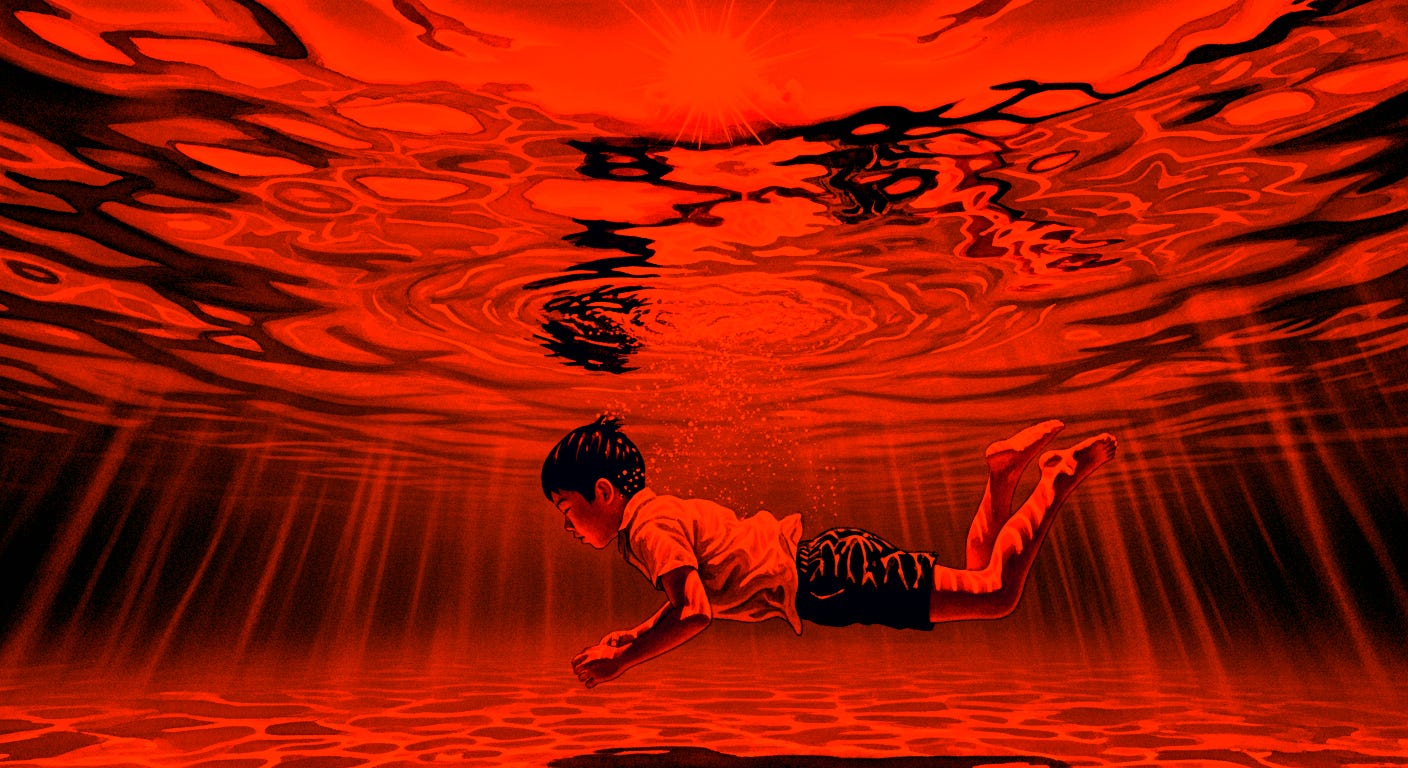
The recent eightieth anniversary commemorations of the Nagasaki bomb have brought back memories of those Cold War years when the fear of nuclear annihilation seemed to be a daily weight we felt. Today the risk remains, perhaps even greater, though the fear has fallen silent.
Biblical scripture speaks of the second coming, of a world that can change in an instant. What feels steady and ordinary can be swept away without warning. In Noah’s day, the flood was water. In Nagasaki, it was nuclear fire.
”…they were oblivious, until the flood came and swept them all away. So will it be at the coming of the Son of Man. Two men will be in the field: one will be taken and the other left.” ¹
I have returned many times to one particular account recorded by Frank Chinnock² in 1969. His pages linger on the smallest gestures - a bell thrown into water, a breath taken before diving. In that scene, what was lost becomes visible again.
There is a spot in the upper Urakami River where nature has formed a small pool. That morning a group of ten boys, in colored loincloths, was playing a game called “find the bell.” One of the boys, 11-year-old Koichi Nakajima, had a little gilded bell. He would throw it in the water, count to three and they all would dive after it. The first to find it won the game.
Now Koichi held up the tiny bell and shouted, “Here we go! One, two, three.” There were ten splashes as the boys dove for the prize. But the river had become roily, and no one found it.
Koichi began to get worried. He had taken the bell from his sister’s workbox without her permission. She would be very angry if he lost it. He surfaced, took a deep breath, and eeled his way down to the bottom.
Nine seconds later, the bomb exploded over his head. When Koichi surfaced, he heard two of the other boys screaming with pain. He stared around in fright. There were bodies of his friends on the riverbank, and beyond them he saw that all the houses had been knocked down. What had been a beautiful city a moment before was now a wasteland with a big, black cloud rising above it like smoke from a funeral pyre. Though it was deathly hot, Koichi’s teeth began to chatter.
When the plutonium bomb exploded, fantastic energy was released in the form of heat, light, gamma radiation and pressure. The exact number of people killed will never be known. The prewar census count is meaningless, and because people were constantly moving in and out of cities, no pre-raid population figure has been determined. Also, many people were burned beyond recognition or were simply obliterated. Finally, hundreds were disposed of in mass cremations, while other hundreds fled to the country and mountains to die unrecorded.
I don’t know if Koichi ever found his sister’s bell, or if his sister survived to be angry with him. The river kept that secret. But I think of that small gilded bell somewhere in the silt, and I think it matters that we remember these boys had names, that there was a game, that someone’s sister owned a bell.
The world that was destroyed was made of such small domestic worries, and we diminish both the dead and ourselves if we remember only the magnitude of the destruction and forget the magnitude of what was lost.
This moment in time shows how precious the ordinary is: the many lives bound to ours, the voices we know, the small treasures we search and keep. All of it given, all of it fragile, all of it held for a time, like a breath before the plunge.
¹ Matthew 24:39–40
² Chinnock, F. W. (1969). Nagasaki: The Forgotten Bomb. World Publishing Company.