Moholy-Nagy and the Art of Remote Creation
It is Germany, 1922. László Moholy-Nagy lifts the receiver of a telephone. On the other end, a porcelain-enamel factory in Weimar (Figure 1). Calmly, almost bureaucratically, he dictates: “Three panels. A yellow square. A black line. A red square in the corner” [1], [2].
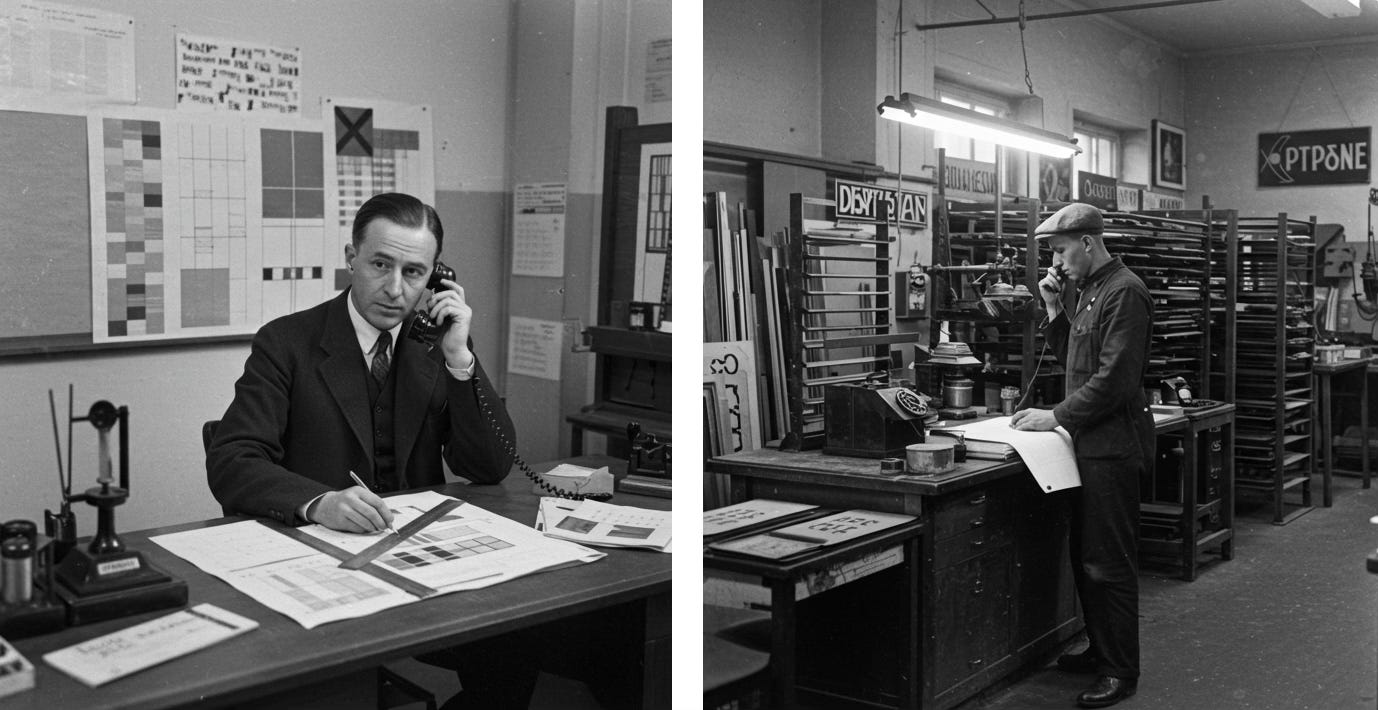
A worker writes it down, following procedure with a colour chart and a sheet of graph paper. Nothing more. No trembling hand of the artist, no fevered gesture of inspiration. Just instructions, processed and executed. The result: three enamel panels, with EM 1 Telephonbild (Telephone Picture) (Figure 2) as the first, as described [4]. A creation Moholy-Nagy never physically touched, yet one that bears his name.
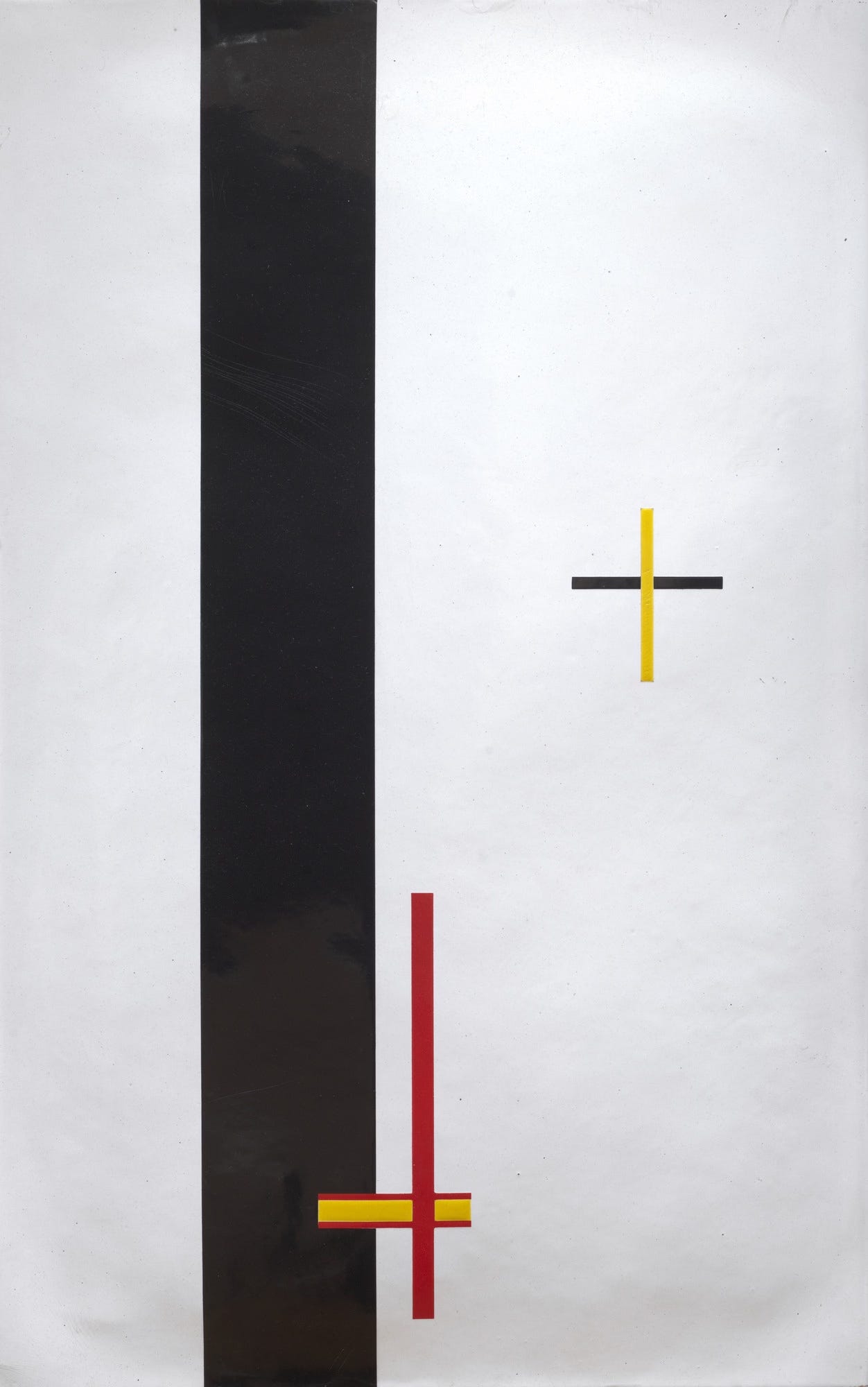
These panels are not traditional painterly works. They are conceptual designs brought to life by factory hands, embodying “art as information.” Some have described this as a forerunner to digitisation, where ideas transcend the artist’s direct touch, realised instead through systematic execution [5], [6]. In a sense Moholy-Nagy anticipated our present AI delirium [6], [7]. A world where an artist no longer paints, but prompts. No longer carves, but curates. Where the telephone becomes a collaborator. A century later, we are back on that line. Only now the voice that listens, listens back. It learns. It suggests. The anxiety is familiar. In Weimar, the fear was that machines would strip human beings of their essence, reducing life to mechanical noise [8], [9]. Today, it is algorithms that threaten to erode what we think of as human. They are silent, ambient, impossible to grasp. Yet Moholy-Nagy’s wager was not despair but optimism [10], [11]. He believed that technology could expand the field of human experience rather than compress it. That art might be a shared atmosphere of instructions and responses, drifting free of the solitary studio. László Moholy-Nagy placed great emphasis on our perceptual capacity, where seeing, feeling, and thinking converge as we move [11], [12]. Preparing the senses does not guarantee novelty, but it does invite unpredictable creative avenues with form, light, and motion. Seen this way, the Telephone Picture was never simply enamel on steel [2]. It was a parable about how to live with systems we cannot fully control, but with which we must learn to converse. To dial, and be dialled in return. The conversation itself becomes the artwork. To design in such a space is to design in a white water world, where stability is fleeting and flow is the constant, as John Seely Brown suggests [13]. This was Moholy-Nagy’s true provocation. A question that remains unresolved in every AI prompt we type: If I conceive it, must I make it? While others recoiled from the encroaching machine, Moholy-Nagy leaned forward, convinced that technology was not an end of art, but a transformation of it [1], [10], [14]. The brushstroke replaced by the spark of instruction. A hundred years on, we are still whispering into the receiver: “blue circle here, yellow field there.” And the machine still replies.
References
- K. Passuth, Moholy-Nagy. London: Thames, Hudson, 1985.
- M. S. Witkovsky, “Moholy-Nagy’s Painting after Photography,” October, vol. 115, no. Winter, pp. 35–64,2006.
- M. Maré and Imagen, “Reconstruction of László Moholy-Nagy giving instructions by telephone to an enamel factory worker, Weimar, 1922.” Aug. 2025.
- L. Moholy-Nagy, “EM 1 Telephonbild (Telephone Picture).” [Online]. Available: https://www.moma.org/collection/works/147626
- B. H. D. Buchloh, “Conceptual Art 1962–1969: From the Aesthetic of Administration to the Critique of Institutions,” October, vol. 55, pp. 105–143, 1990.
- E. A. Shanken, Art and Electronic Media. London: Phaidon, 2009.
- R. Banham, Theory and Design in the First Machine Age. New York: Praeger, 1960.
- W. Benjamin, “The Work of Art in the Age of Its Technological Reproducibility,” Illuminations. Schocken,New York, 1968.
- A. Huyssen, After the Great Divide: Modernism, MassCulture, Postmodernism. Bloomington: Indiana UniversityPress, 1986.
- L. Moholy-Nagy, Painting, Photography, Film. Cambridge,MA: MIT Press, 1969.
- L. Moholy-Nagy, Vision in Motion. Chicago: PaulTheobald, 1947.
- C. Keller, The Bauhaus and Its Legacy. New York:Schocken, 1997.
- J. S. Brown and P. Duguid, The Social Life of Information.Boston: Harvard Business School Press, 2000.
- E. Lupton and J. A. Miller, Letters from the Bauhaus. NewYork: Princeton Architectural Press, 1991.